The first answer sets the tone
“Tell me about yourself” usually comes first. A slow, clear opening buys you the rest of the interview.
Knowing your answer and saying it well are two different skills. Interviews reward a calm start, a clear point and an answer that ends on purpose. Say your answers out loud, hear them back and fix one thing at a time.
Starts with your free Voice Snapshot: one minute of you talking about an interview, measured. No account needed.
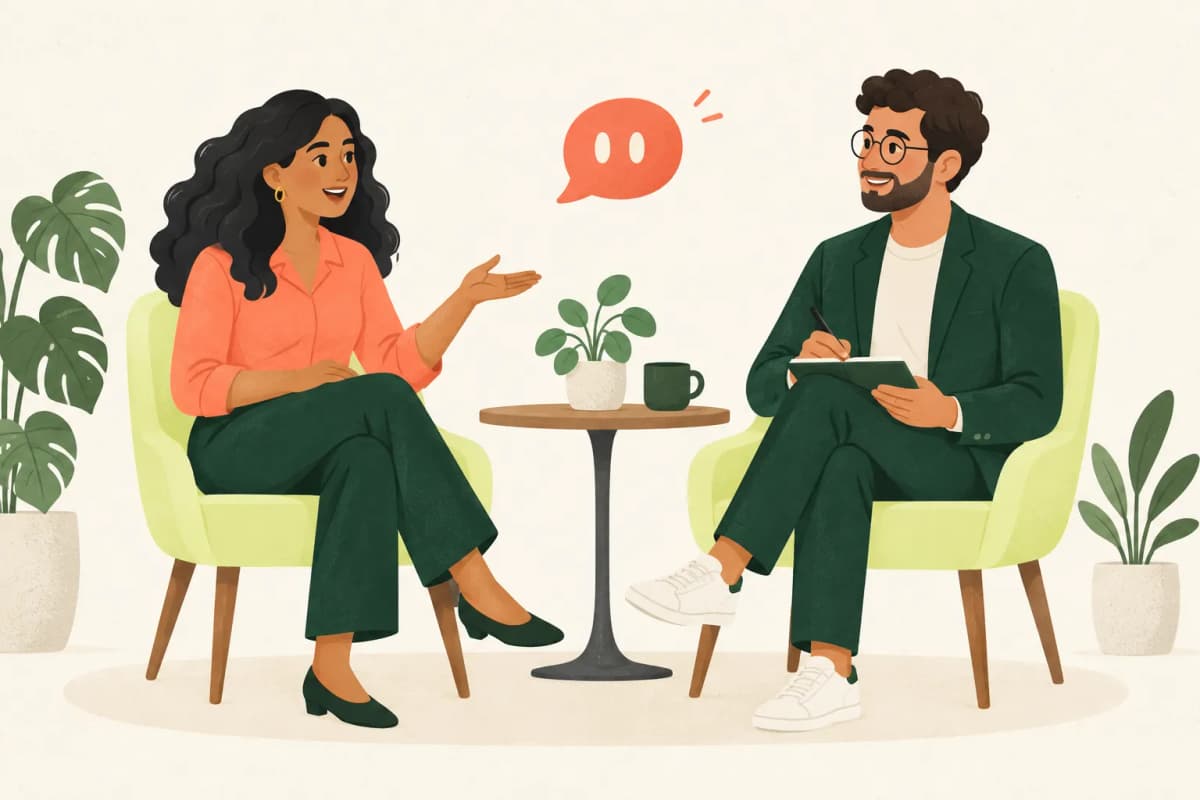
WHAT USUALLY GOES WRONG
“Tell me about yourself” usually comes first. A slow, clear opening buys you the rest of the interview.
When the weakness question lands, most people rush. A short pause before you answer sounds thoughtful.
You make the point, then keep talking. Ending on purpose is something you can practise.
Most interviews use some version of these, whatever the job. You can't script the whole hour, but you can walk in with a shape for each one. At a comfortable 130–150 words a minute, a minute of speaking is about 130–150 words.
60–90 seconds, about 130–225 words
Start with what you do now and one result you can say without a calculator. Then one or two past steps that explain why you're here. Finish with why this role is the obvious next one. Leave out your childhood, and your degree title unless it's the point.
45–60 seconds
Name one specific thing about the company or the team that you've looked into: a product, a project, the way they work. Say what you'd bring to it. Then join the two in one sentence. “I love your mission” doesn't count as specific.
45–60 seconds
Pick a real weakness that won't sink this particular job. Say what it cost you once, what you do about it now, and how it's going. Then stop. The answer gets weaker the longer you justify it.
Say it like this
I used to say yes to every request, and twice that meant missing a deadline.
Now I check my week before I agree to anything new.
I still have to remind myself, but I haven't missed one this year.
90 seconds to 2 minutes
This is STAR. Keep the situation and task to two sentences, because most people spend half the answer setting the scene. Spend the time on what you did, in the first person, and finish on the result. If the result was mixed, say so and say what you'd do differently.
20–30 seconds
In an early screen you can turn it round: “I'd like to understand the full role first. What range have you budgeted?” If you give a figure, say it once, let your voice fall at the end and then stop talking. In negotiation experiments, first offers strongly predicted the final price (Galinsky and Mussweiler, 2001), so it's worth practising the number out loud. Practise saying your number, free.
About 30 seconds each
Always have two. Ask about the work itself: what a good first six months looks like, or what the team is working on that you'd join. Then close with one line on why you want the job. Save pay and holidays for when there's an offer.
Written answers come out long. Spoken ones need short sentences, one number at a time and a planned last line. Here's “Tell me about yourself” for a marketing coordinator. Each slash is a place to pause. Our guide to “Tell me about yourself” has four more: an engineer, a career changer, a graduate and someone returning after a break.
Right now I'm a marketing coordinator at a small travel company. / I look after our emails and our social channels.
This year I more than doubled our mailing list, / mostly by testing one change a week and keeping what worked.
One of those tests, a shorter subject line, / is now how we write every email.
Before that I spent two years in customer service. / I answered the same questions every day, / so I learned what people actually ask, / and that still shapes everything I write.
Next, I'd like a bigger team and a product I can go deeper on. / Your app kept coming up when I looked at travel planning tools, / and this role leans on testing and customer insight, / which is the part of my job I enjoy most.
That's why this is the role I applied for.
No “so, basically” at the start, no list of every job, and no “and yeah, that's me” at the end. The last line was planned before the first one was said.
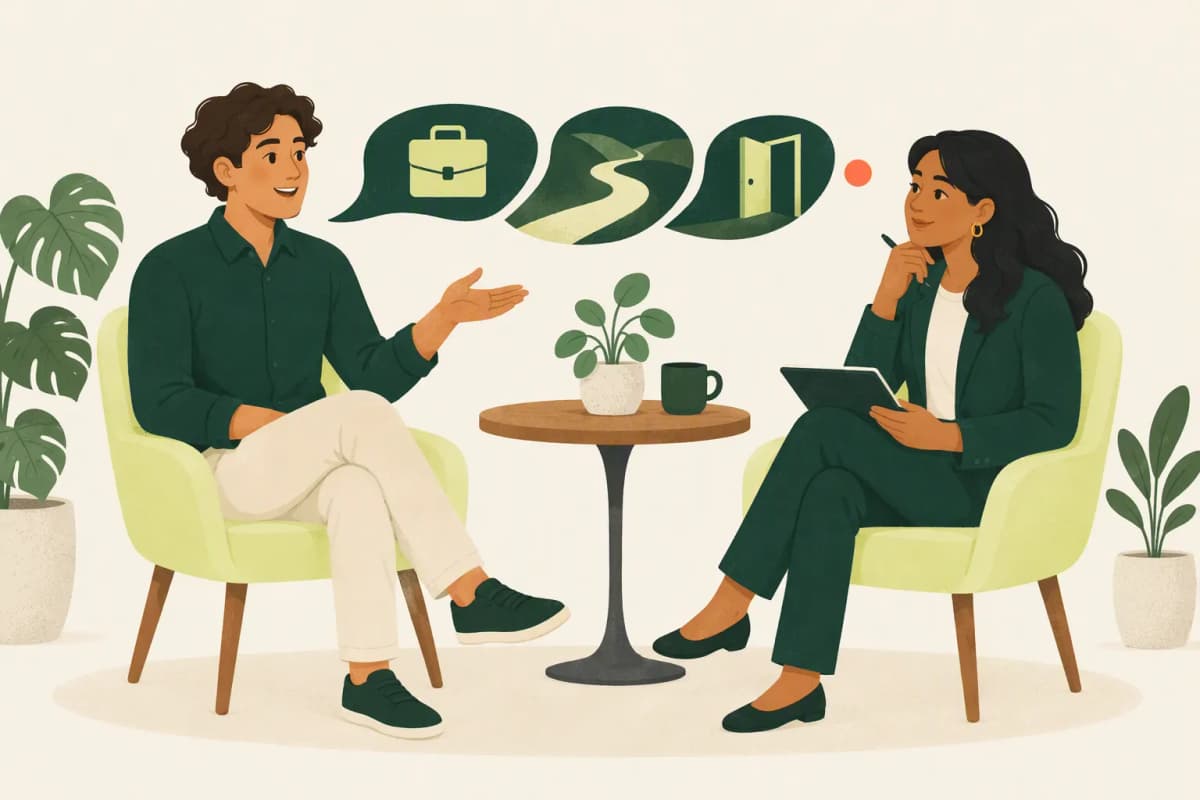
The opening minutes count. In one study of structured interviews, impressions formed during the opening small talk were linked to how candidates were rated later, and to whether they got internship offers (Barrick, Swider and Stewart, 2010). It was a correlation, with students applying for internships, but it's a good reason to rehearse your first minute.
WHAT PRACTICE LOOKS LIKE
Each rep is two short takes: one to hear where you are, one after a single cue from your coach. Chapter 1 is free; later chapters are part of Pro.
Chapter 1 · The Mirror
The rep asksAnswer: "Why do you want this role?"
Chapter 5 · Structure
The rep asksWhy do you want this job?
Chapter 1 · The Mirror
The rep asksWhat's your biggest weakness?
Chapter 7 · Under Pressure
The rep asksThe interviewer asks: "Why did you leave your last job so soon?"
Chapter 10 · Showtime
The rep asksClose the interview: why you, and why now.
WHAT YOU'LL PRACTISE
Pace, pauses, fillers, melody and punch are measured on every take, and your coach quotes your own words. How it works
Three short sessions over a few days work better than one long panic the night before. Each take in the app runs up to 90 seconds, which suits interview answers well.
Day 1
Record your free Voice Snapshot with the interview prompt, “Tell me about yourself”. Don't prepare. Listen back once and note the first thing you'd change: the warm-up, the pace or the ending.
Day 2
Write the shape for each of the six questions above, with just a few words per step. Say each one out loud twice. Time “Tell me about yourself” and cut until it fits in 90 seconds.
Day 3
Answer three of the questions cold, one take each, as if they'd just been asked. Then do the free “Before your big moment” routine: breathe out, say your first line slowly, run it once. With Pro, a live AI interviewer asks follow-ups for up to five turns, then shows how you did.
On the day
Before you go in or join the call: one breath reset, then your first line, slowly. Leave the rest alone.
GUIDES, TOOLS AND QUIZZES
For most questions, between one and two minutes. “Tell me about yourself” works well at 60–90 seconds, which is about 130–225 words at a comfortable pace. If you're past two minutes, stop and ask whether they'd like more detail.
Memorise the shape and your first and last lines. Keep the middle loose. A fully memorised answer tends to come out fast and flat, and it's hard to recover if you lose your place.
Pause, breathe out and say something true and simple, like “Let me think of the best example.” Then give the situation in one sentence and carry on. A few seconds of quiet feels long to you and normal to them.
Yes. A one- or two-second pause before a hard question sounds considered. You can also repeat the key words of the question back to give yourself a moment.
Don't try to stop every one. Find where they cluster, usually at the start of each answer, and practise beginning on a real word after a breath. Our guide on how to stop saying um has drills for this.
Yes, for your voice. It measures pace, pauses, fillers, melody and energy on each take. It doesn't watch your face or body language, and it doesn't give feedback during a live call.
Record one answer now and see what your listeners will hear.
Rehearse my interview answerAlso: Meetings · Presentations · Life moments