JOB INTERVIEWS · YOUR OPENING ANSWER
How to answer “Tell me about yourself” (and say it well)
A structure that fits in 90 seconds, five sample answers written to be spoken, and a way to hear yours before the interviewer does.
Written by the SpeakConfident team · Updated · Part of our interview practice guides
The short answer
Answer “Tell me about yourself” in about 60 to 90 seconds with present, past, future: what you do now plus one result, the experience that brought you here, and why this role is your next step. Start on your current role, not your childhood. Rehearse it out loud, time it, and finish on one clear line.
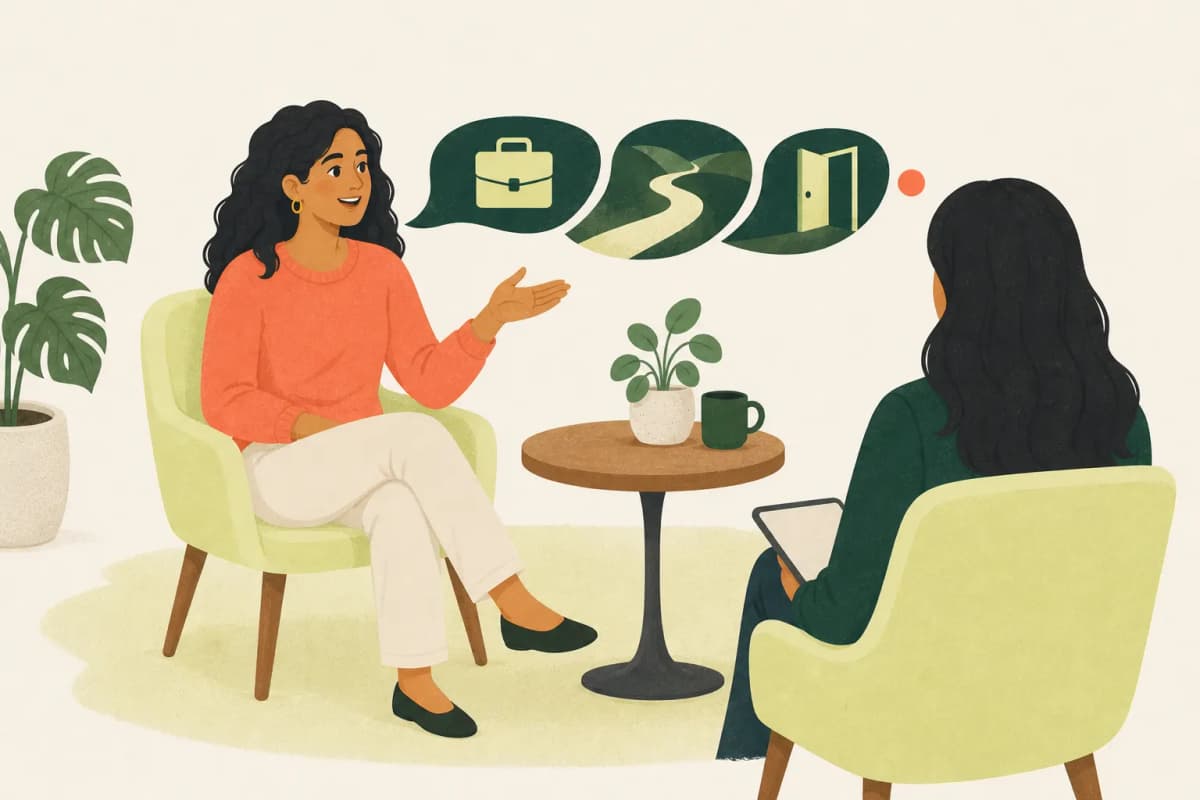
It's usually the first question, and it sounds the easiest. Then you start talking and hear yourself say “So, um, basically, I grew up in…” and you're three minutes in with no end in sight.
What they want is a short pitch: who you are now, what led you here, and why this job is the obvious next step. Most advice online gets that structure right. What it skips is the part the interviewer actually hears: your voice, your pace and your last line.
This guide gives you the structure, five sample answers written to be said out loud, with word counts and timings, and a free way to record yours and hear it back before the real thing.
What the interviewer is really listening for
The interviewer is listening for three things: what you choose to mention, how clearly you say it, and something to ask you next. The question is open on purpose.
- Relevance. Out of everything you could say, did you pick the parts that matter for this job?
- How you communicate. Can you give a clear, short account of yourself without notes?
- A hook. A good answer leaves a thread to pull, such as a result they'll want to hear more about.
The opening minutes seem to carry weight. In one study of structured interviews for internships, candidates who made a better impression in the short rapport-building stage at the start got higher ratings later in the interview, and more internship offers.[1] The links were modest (correlations of .42 with later ratings and .22 with offers), and the study measured correlation, not cause. It looked at the small talk at the start, not this answer, but it's a fair reason to rehearse your first minute most.
This answer also sets the agenda: whatever you mention, they're likely to ask about, so mention what you'd love to discuss.
The structure: present, past, future
Use three parts in this order: what you do now, what brought you here, and why this role is next. Starting in the present puts the most useful fact first and stops you drifting back to school.
Right now, I… / and recently I [one result].
Before that, I… / which is where I learned…
That's why I'm excited about this role: / …
Present: your role and one result
One sentence on what you do, then one result you can say without a calculator. “I cut our response time from three days to one” is easy to say and easy to remember. “I improved operational efficiency by 23.7% across Q3” is gone by the next sentence.
Past: one or two experiences, not your CV
Pick the one or two things that explain why you're sitting there. They have your CV. What they need is the thread that connects it: why you moved from customer service into marketing, say.
Future: why this role, why now
Name something specific about this job or this organisation. “I'm looking for a new challenge” could be said in any interview. “You're opening two new sites next year, and that's the kind of project I've run before” could only be said in this one.
When to flip the order
- Changing careers: start with the thread that connects your old work to the new one (“For six years I've been helping people learn things they find hard”), then your current role, then why this move.
- Graduates: start with something you've done, such as a project, a job or a role in a society, rather than your degree title. Then the degree, then why this scheme.
- Returning after a break: one honest, calm sentence about the gap, then straight on to what you're ready to do now. You don't owe anyone the details.
Career advisers say much the same. The University of Warwick's careers service calls the answer a trailer, not the director's cut, and says it isn't an invitation to share your life story.[2]
How long should “Tell me about yourself” be?
Aim for 60 to 90 seconds. That covers present, past and future and leaves room for follow-up questions, where the real conversation happens.
There's no research-backed ideal. The Muse, which publishes one of the most-read guides to this question, says plainly that there's no scientifically proven optimal length, and that coaches' advice runs from 30 seconds to two minutes.[3]
In words: at a comfortable 130 to 150 words a minute, 60 seconds is about 130 to 150 words, and 90 seconds is about 195 to 225.
Treat those numbers as a guide. Speaking rate depends a lot on the person and on how you measure it. In one large study of recorded phone conversations, the same recordings came out at 164, 196 or 236 words a minute depending on whether pauses and the other speaker's turns were counted.[4] Your own pace is the number that matters, so time yourself.
How many words fit in 90 seconds?
Set to 90 seconds already. Switch to “Paste a script” and paste your draft answer to see how long it takes to say. Everything stays in your browser.
1 min 30 s is about 195 to 225 words.
For 1 min 30 s, write about
195–225 words
At a typical 130–150 words per minute. That is about 1 page double-spaced.
- Slow 120 wpm180 wordsDeliberate delivery: ceremonies, big echoey rooms, dense material, or listeners in their second language.
- Conversational 140 wpm210 wordsTalking it through in your own words, with natural pauses while you think.
- Rehearsed 150 wpm225 wordsA script you know well. No searching for words, so it runs a little quicker.
- Fast 170 wpm255 wordsNerves, excitement or a squeezed slot. Easy to slip into, hard for listeners to follow for long.
Not sure which pace is yours? Read a passage aloud and time yourself. It takes about a minute.
Over 250 words is too long to say well. Cut the past section first: it's usually the longest part and the one the interviewer needs least. For a target that fits a one-minute slot, see our 1-minute speech guide.
Five sample answers, written to be said out loud
Most sample answers online are written to be read: long sentences, three numbers in a row, no place to breathe. These are written to be said. Every sentence is under 20 words, with at most one number in it. A single slash (/) marks a short pause; a double slash (//) marks the longer pause before the closing line.
Timings assume 140 words a minute, the middle of the comfortable range above. Borrow the shape, not the words.
Right now I'm a marketing coordinator at a furniture brand in Leeds. / I run our email programme and our social media calendar. /
Last spring I rebuilt our welcome emails from scratch, / and sales from new subscribers went up by a third. /
Before that, I spent two years in customer service at the same company. / That's where I learned what customers actually ask about. /
I started writing our help emails because the old ones confused people. / My manager noticed, and moved me into marketing. /
What I want next is to own a channel from start to finish, / with the numbers to show what's working. /
That's what drew me to this role in particular. / You're growing your email list fast, / and the job covers strategy as well as sending. //
I know what customers ask, / and I'd love to help you answer it at scale.
The result: sales up by a third. The closing line ties the past to the role.
I'm a backend engineer at a payments company. / I look after the systems that check card payments for fraud. /
Last year I led our move to a new database. / We did it with no downtime, / and our customers never noticed, which was the point. /
I got into engineering through a maths degree / and a summer job fixing spreadsheets that kept breaking. / I wanted to build things that didn't break. /
I've spent four years doing that, mostly in small teams. / The part I enjoy most now is helping newer engineers ship their first big change safely. /
That's why this role stands out. / It's a senior post with real mentoring in it, / and your platform team is about to do the same kind of migration I've just finished. //
I'd like to help you do it calmly, / and grow into leading a team while I do.
The one result: a database move with no downtime. There's no list of languages and frameworks: those are on the CV.
For six years I've been helping people learn things they find hard. / Most of that time I've taught science at a secondary school in Bristol. /
Along the way, I trained the teachers in my department to use our new online platform. / That's where I found what I want to do next. /
Adults learning a new system have the same worry as teenagers: / they don't want to look slow. /
I designed a short course for our staff, / and within a term every teacher in the department was using the platform. /
Since then I've completed a certificate in learning design, / and I've built two online modules for a local charity. /
I'm applying because this is the same job with a different audience. / You need people who can make a new process feel easy. //
That's what I've been doing in the classroom, / and I'd like to do it for your teams.
This one opens on the thread, so the interviewer hears “helping people learn” before “teacher”.
For the last year I've run the data side of a student project on cycling safety, / alongside my geography degree at Sheffield. /
We mapped every reported cycling accident in the city over five years. / I cleaned the data, built the maps, wrote the report, / and presented them to the council's transport team. /
Two of the junctions we flagged are now being redesigned. /
That project taught me I love turning messy numbers into something people can act on. /
I also worked weekends in a busy café, / which taught me to stay calm when everyone wants something at once. /
I'm applying for your graduate analyst scheme / because it puts new analysts on real projects from the first month. / I want to learn how a big organisation uses data to decide things. //
And I'd bring the same care I put into that cycling map.
A student project can give you a real result. The café job earns its place because it says how you work.
I'm a project manager, / and most of my career has been office moves and refits for a property firm. /
My biggest was moving four hundred people into a new building over one weekend, / with everyone at their desks on Monday morning. /
Two years ago I took a break to care for my dad. / He's well looked after now, / and I'm ready to come back. /
During the break I kept my project management qualification up to date, / and I ran the refurbishment of our village hall as a volunteer. / It finished on time and a little under budget. /
What I'm looking for now is a role close to what I did before, / with a team that values careful planning. /
Your facilities team is opening two new sites next year. //
That's exactly the kind of work I've done well, / and I'd like to do it again here.
The break gets two short sentences, said calmly, then the answer moves on. Treat the gap as normal and most interviewers will too.
Written version
So, I'm currently a marketing coordinator with over two years of experience across email, social and CRM, where I've driven a 34% uplift in new-subscriber revenue and a 12% increase in open rates, having previously worked in customer service, which gave me a strong understanding of customer pain points, basically.
1 sentence, 53 words, 3 numbers, 2 fillers, no place to breathe
Spoken version
Right now I'm a marketing coordinator. I run our email and social. Last spring I rebuilt our welcome emails, and sales from new subscribers went up by a third.
3 sentences, 30 words, 1 number, 0 fillers
Both say the same thing. The second can be said one breath per sentence, and “a third” is easier to say and remember than “34%”.
Say it out loud: the three-take method
Rehearse this answer out loud, not in your head. A sentence that reads well can be a mouthful to say, and you only find out by saying it.
Practice seems to help. In a study of 213 police and fire service candidates preparing for promotion interviews, those who went to interview coaching did better in the interview, even after allowing for their job knowledge and motivation. Role-play and study groups helped on top of that, and candidates who prepared more gave better-organised answers.[5] It's one study in one setting.
Take one: say it without notes, and don't stop
Record yourself answering from the top. If you stumble, keep going. You're finding out what it sounds like today.
Listen for three things
- Starter words. Does your first sentence start with “So”, “Basically” or “Um”? The first sound is the one they hear first.
- Pace in the first sentence. Nerves push most people faster at the start. Is your first sentence quicker than the rest?
- Your last sentence. Does it land, or does it trail off into “so, yeah, that's kind of me”?
Take two: change one thing. Only one.
Pick the biggest of the three and fix only that. Then record again and compare. One change at a time is how it sticks.
REHEARSE IT
Say it out loud now
Try thisTell me about yourself and what you're looking for in your next role.
60 seconds. Free. This is the exact prompt the interview Snapshot uses. You'll see every filler, your pace and whether you rushed the end, then you can try it again.
Record my answerNo account needed for your first take. Your audio stays private. The app gives you its own one-minute prompt; use it, or answer this one.
If nerves take over
Interview nerves are normal. Researchers who built a scale for job interview anxiety found it covers several worries at once, such as communicating, appearance and performing, and that together these scores were related to how candidates did.[6] Rehearsal won't remove nerves, but an answer you've said many times gives them less to grab.
One physical trick helps: before you start, breathe out slowly for a count of four. Then say your first word. Our guide to stopping saying um has more on pausing.
Your first and last sentences
Plan your first and last sentences word for word, and keep the middle flexible. They're where people stumble, and what the interviewer remembers.
The first sentence
Start on a real word, a little slower than feels natural. “Right now I'm a project manager at…” beats “So, um, where do I start?” If you need a moment, take it in silence before you begin. A one-second pause before your first word sounds composed. If you tend to rush, our guide on how to speak slower has drills for exactly this.
The last sentence
End on purpose. People remember how you end, so finish with one line that ties you to this role, say it slowly, and stop. Then let the silence sit. The interviewer will pick it up.
That's why I'm here: / I've done the hard part of this job once, / and I'd like to do it again with you.
On video and on the phone
The structure stays the same on a screen. The delivery changes.
- Slow your first sentence even more. Calls often clip the start of what you say.
- Look at the camera for your closing line. Looking at their face on screen reads as looking down. Find the lens for the last sentence, at least.
- Don't read from the screen; it shows in your eyes and your voice. Use three keywords on a sticky note.
- On the phone, keep your pauses, but make them a little shorter. Without a face to watch, a long silence can sound like the line has dropped.
Five mistakes that cost you
- The life story. Starting with where you grew up or what you studied years ago. Start in the present.
- Reading out your CV. They have it. Pick the thread instead.
- A memorised script said at speed. Learn your first and last lines; let the middle vary.
- Negativity about your current job. It's the line they'll remember. Talk about what you're moving towards.
- No ending. Trailing off with “so, yeah” leaves them unsure you've finished. Say your closing line, then stop.
If your answers tend to run long in general, our guide on how to stop rambling has a drill where you say the same answer in half the time.
Practise this in the app
Each rep is two short takes: one to hear where you are, then one after a single cue from your coach.
- Chapter 1 · The MirrorFreeYour real moment
Breathe out first. Pause instead of um.
- Chapter 1 · The MirrorFreeDrop the starter words
Start every sentence on its first real word.
- GymFreeBefore your big moment
Breathe out for four counts. First line slow, then keep going.
- Chapter 5 · StructurePoint first
Give your answer in the very first sentence.
- Chapter 10 · ShowtimeOwn the first 30 seconds
Open with a moment, a question or a fact. No thank-yous.
- Chapter 10 · ShowtimeThe closing line
Build to one final line. Slow it down, land it, stop.
- Chapter 10 · ShowtimeThe pitch
Problem, your idea, one proof, your ask.
QUESTIONS
Questions people ask
Should I memorise my “tell me about yourself” answer?
Memorise the first and last sentences, and the order of the three parts. Leave the middle loose. A fully memorised answer tends to come out fast and flat, and one interruption can throw you. Rehearse it out loud five or six times, saying it slightly differently each time, until the shape is automatic and the words can change.
What should you not say when asked to tell me about yourself?
Skip your childhood, your full employment history, anything negative about your current employer, and personal details that don't relate to the job, such as relationship status or health. Avoid clichés like “I'm a perfectionist” or “I'm a people person” unless you follow them with a real example. And don't end with “so, yeah”.
What if I go blank halfway through?
Stop, breathe out slowly, and restart from the present: “Right now, I'm…”. Going back to the first part of the structure is the easiest way in. A short pause looks like thinking. If the blank lasts, it's fine to say “Let me come back to the main point”, then give your closing line.
Is “walk me through your CV” the same question?
Nearly. “Walk me through your CV” invites a little more history, so it's fine to take the past section in order, briefly. Keep the same shape and length: start with where you are now, cover the moves that explain your path, and finish on why this role. It still shouldn't be a reading of every job.
How is it different from my cover letter?
Your cover letter is read, so it can hold detail and precise numbers. This answer is heard once, so it needs fewer facts, shorter sentences and one memorable result. Use the same story, but not the same words. Read your letter aloud and you'll hear why: the sentences are too long to say comfortably.
Sources
- Barrick, M. R., Swider, B. W. & Stewart, G. L. (2010). Initial evaluations in the interview: relationships with subsequent interviewer evaluations and employment offers. Journal of Applied Psychology, 95(6), 1163–1172. Structured internship interviews: better impressions in the opening rapport stage correlated with later interviewer ratings (r = .42) and internship offers (r = .22). Correlational; about the opening small talk, not this answer specifically. We read the abstract on PubMed. Accessed 15 October 2026.
- University of Warwick Student Careers (revised 11 April 2025). How to answer “Tell me about yourself” in an interview. A UK careers service's advice: think of the answer as a trailer, not the director's cut. Gives no length in seconds. Accessed 15 October 2026.
- Ziv, S. The Muse (updated 10 March 2025). Answering “Tell me about yourself” in an interview. Says there's no scientifically proven optimal length and that coaches' advice ranges from 30 seconds to two minutes. A careers publication, not research. Accessed 15 October 2026.
- Yuan, J., Liberman, M. & Cieri, C. (2006). Towards an integrated understanding of speaking rate in conversation. Interspeech 2006. Switchboard telephone conversations: 196 words a minute over total time, 236 excluding silences, 164 per speaker's own turns. Casual phone calls, not interviews. Accessed 15 October 2026.
- Maurer, T. J., Solamon, J. M., Andrews, K. D. & Troxtel, D. D. (2001). Interviewee coaching, preparation strategies, and response strategies in relation to performance in situational employment interviews. Journal of Applied Psychology, 86(4), 709–717. 213 police and fire promotion candidates. Coaching attendance, role-play and preparation were linked to better interview performance and better-organised answers. Correlational, one setting. We read the abstract on PubMed. Accessed 15 October 2026.
- McCarthy, J. & Goffin, R. (2004). Measuring job interview anxiety: beyond weak knees and sweaty palms. Personnel Psychology, 57(3), 607–637. Develops a five-part measure of interview anxiety with students (N = 212) and job applicants (N = 276); together the scales were related to interview performance (multiple correlation .34). We read the abstract. Accessed 15 October 2026.
Then the next question
Twenty questions interviews really ask, each with a shape and a target length. Answer one, see your Replay, change one thing, and say it again.
Practise interview questionsThree questions are free. The rest are part of Pro, and your 7-day free trial includes them.