MEETINGS AND INTERVIEWS · SAYING LESS
How to stop rambling: say it once, clearly, and stop
Work out which kind of rambler you are, then practise the one fix that matches, out loud, until the short version comes first.
Written by the SpeakConfident team · Updated · Part of our guides for meetings
The short answer
To stop rambling, decide your point before you speak and say it in your first sentence. Add one or two reasons or an example, then stop, even if there's a silence. A simple shape helps: what, so what, now what. Practise by answering a question out loud, then saying the same answer again in half the time.
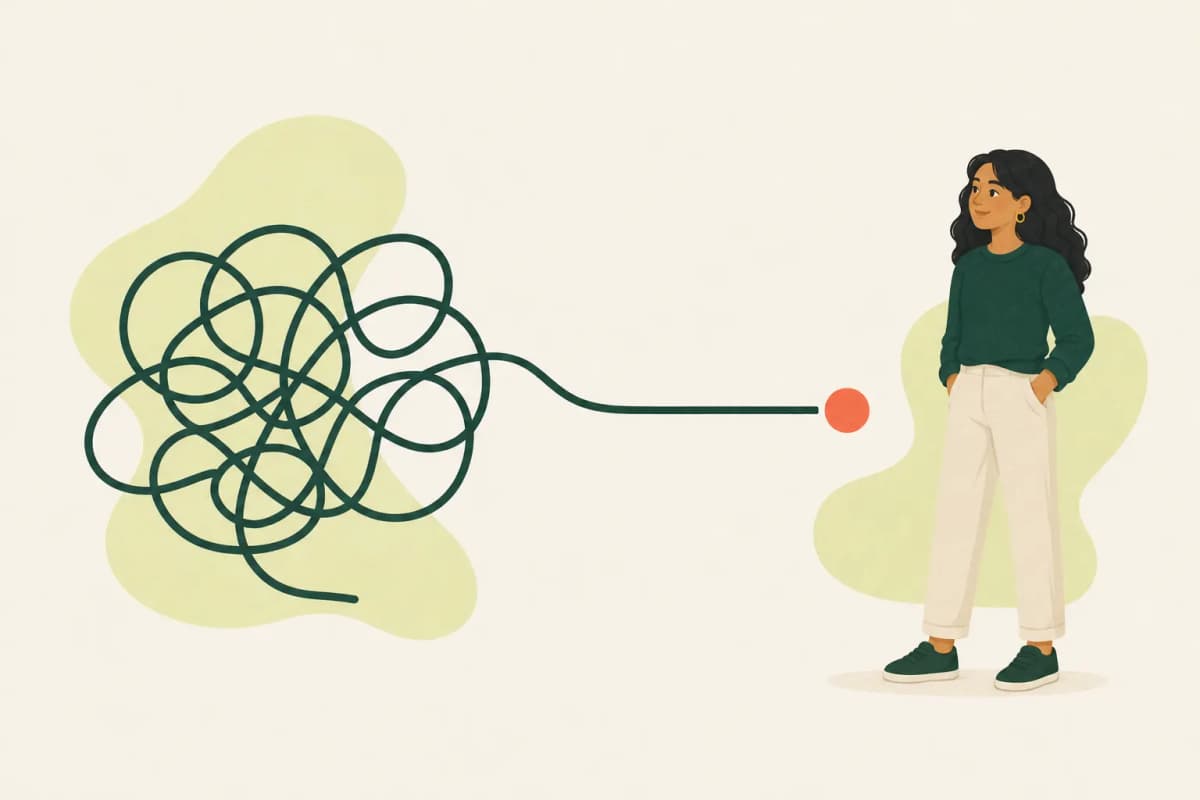
You know the feeling. Someone asks a simple question, you start answering, and somewhere around the third “and also” you realise you've lost the thread. So has everyone else.
Usually it happens because you know a lot, you're thinking while you talk, and you haven't decided where to stop.
The fix is a habit you can practise. Say the point first. Give a reason or an example. Then stop, and let the silence do some work. This guide helps you spot which kind of rambler you are, and gives you drills to practise out loud, including one where you say the same answer in half the time.
Why do I ramble when I talk?
Most rambling happens because you're working out what you think while you say it. Writing lets you draft, cut and reorder. Speaking doesn't, so the first draft comes out live, warm-up and tangents included.
A few things make it worse:
- No decided point. If you don't know your answer before you start, you talk until you find it.
- Nerves. Under pressure, silence feels risky, so you keep adding words to fill it.
- Fear of being misunderstood. You add one more caveat, one more bit of background, just in case.
- No planned ending. Without a last line, there's no obvious place to stop, so you circle.
Researchers have a name for one version of this: off-target verbosity, meaning long speech that lacks focus. In a study of 205 adults aged 61 to 90, it was linked to finding it harder to hold back loosely related thoughts.[1] That study was about older adults, but the idea fits everyone: rambling is often a thought you didn't filter, not a thought you didn't have.
It isn't always a problem, either. In another study, older adults wandered off topic more than younger adults when telling stories about their lives, and listeners rated their stories as better.[2] Over dinner, a winding story can be a gift. In a meeting or an interview, where people want an answer, it costs you.
Three kinds of rambling (which is yours?)
Most people ramble in one of three places: before the point, during it, or after it. Each has a different fix, so it's worth knowing yours. Record yourself answering a work question for a minute and listen for where the extra words go.
1. The long warm-up
You start with throat-clearing: “So, yeah, that's a good question, I think, well, it depends…”. By the time the point arrives, people have stopped listening for it.
Fix: cut it. Your first sentence is the point. In the app this is the rep “Cut the warm-up”, with the cue “Skip the lead-in. Your first sentence is the point.”
2. The tangent
You start well, then one detail reminds you of another, and that one of a third. Each bit is interesting. Together they bury the answer.
Fix: headline first, then two details at most. Like a news story: the headline, then only the detail people need. Anything else can wait until someone asks.
3. Can't find the ending
You make your point clearly, then keep going: you repeat it, soften it, add “but anyway” and say it a third time. You've finished, but you don't know how to stop.
Fix: a planned last line. Decide before you speak how you'll finish, such as the decision you want or the lesson you learned, then say it and stop. People remember how you end.
Put the point first
The single most useful habit is to give your answer in the first sentence, then explain. Listeners relax when they know where you're going, and you can stop at any moment without losing the point.
The military calls this BLUF: bottom line up front. The US Army's rules for written correspondence ask writers to put “the main point at the beginning”, and say good Army writing can be understood “in a single rapid reading”.[3] The same rules suggest an average sentence of about 15 words. That's guidance for letters and memos. We've borrowed it for speech because it works even better out loud: a listener can't skim ahead to find your conclusion.
Yes, we should push the launch. / Here's why: testing found two problems we can't fix by Friday.
Try it now
Think of a question you were asked this week. Say your answer out loud in five words or fewer. Then explain it in two sentences. Then stop. That's the shape of a point-first answer.
A shape for any answer: what, so what, now what
When you need more than one sentence, use three moves: what happened, why it matters, and what happens next. Stanford lecturer Matt Abrahams recommends exactly this structure for speaking on the spot, along with a second one: problem, solution, benefit.[4]
Three moves keep you short because each one has a job. Once you've said what's next, you've reached the end, and there's nowhere left to wander.
What: Sales dipped in May. /
So what: That puts the quarterly target at risk. /
Now what: Next week we call every customer who hasn't ordered since March.
What: I sent a client report with last month's figures in it. /
So what: They nearly made a decision on the wrong numbers. /
Now what: I added a two-minute check before anything goes out, and it hasn't happened since.
What: The new website will be two weeks late. /
So what: The spring campaign launches on the old site. /
Now what: I need a yes from you today on the cut-down version, so we keep that date.
You don't say the labels out loud. They're for you, so you know which part you're on and when you've finished.
The “say it in half” drill
The fastest way to stop rambling is to practise saying less on purpose. Your first version of any answer is longer than it needs to be. Say it once, then say the same thing in half the time.
- Take one: answer a question out loud for about a minute. Don't plan it. Just record it.
- Listen back and find the point. Where did it first appear? Most people find it in the second half.
- Take two: same question, 30 seconds. Start with the point you just found. Keep one reason. Drop the rest.
- Take three: one sentence. If you can't say it in one sentence, you haven't decided what you think yet.
REHEARSE IT
Say it out loud now
Try thisAnswer in a minute. Then try it again in 30 seconds.
60 seconds. Free. You'll see your fillers, your pace and where you rushed, then you can do take two and compare.
Record my answerNo account needed for your first take. Your audio stays private. The app gives you its own one-minute prompt; use it, or answer this one.
Take one
So, yeah, the client call, um, it was, I think it went fairly well overall? They had a lot of questions at the start about the timeline, which, you know, is fair, because the last project ran over, and then we got onto pricing, and basically they seemed okay with it, and I think they're going to sign, probably next week.
60 words, 6 fillers, the answer arrives in the last eight words
Take two
It went well. They're signing next week. Their only worry was the timeline, and I've promised them a weekly update.
20 words, 0 fillers, the answer is the first three words
Take two answers the question first, keeps the one detail the listener needs, and stops. Everything cut from take one was true. None of it was needed.
In the app, Chapter 8 (Say Less) is built around this drill. “Say it in half” asks for the same message in half the words, “The one-sentence answer” asks for exactly that, and “The 30-second version” gives you point, reason, ask, finished by 30 seconds.
How to stop when you've finished
Say your last line, then close your mouth. The silence after an answer is where most people start rambling again, because it feels like a sign they haven't said enough.
Silence in conversation is genuinely uncomfortable. In experiments by Namkje Koudenburg and colleagues, a brief silence that broke the flow of a conversation left people feeling uneasy and less included, even when they didn't consciously notice it. In one of the studies, people watched a video of a conversation, and the silence lasted just four seconds.[5]
So don't wait the silence out. Hand the conversation back instead. A short handover line ends your turn on purpose, so the pause belongs to the other person:
“Happy to go into more detail on any of that.”
“Does that answer what you were asking?”
“That's where we are. What would you like to look at first?”
Then wait. If they want more, they'll ask, and now you know exactly which part they want.
Rambling in interviews and meetings
In interviews
Interview rambling usually comes from trying to cover everything in case it's the thing they want. Trust the follow-up questions. Give your point, one example, and a closing line. The first answer is the riskiest: our guide to answering “Tell me about yourself” shows how to fit it into 90 seconds.
In meetings
Meeting rambling is often the long warm-up: background first, point last. Flip it. Lead with what you need from the room (“I need a decision on the budget”), then the reason. If you tend to wait too long and then say too much, our guide on how to speak up in meetings covers when to get in and what to say.
Fillers and rambling often travel together, because both come from planning while you talk. If “um” and “so” are filling your gaps, see how to stop saying um.
Use plain words
Jargon makes answers longer. Every specialist term needs a definition, a caveat or an example, and each one adds a sentence. Plain words do the same job in fewer of them.
The app's cue for this is “No jargon. Explain it like it's to a smart 12-year-old.” That doesn't mean talking down. It means picking the everyday word: “we check every payment for fraud, the way a bank checks a signature” instead of three sentences about risk-scoring models.
Today's drill
Explain the most technical part of your job in 30 seconds to someone outside your field. Record it. Count the words a friend wouldn't know, then do it again with none.
Practise this in the app
Each rep is two short takes: one to hear where you are, then one after a single cue from your coach.
- Chapter 8 · Say LessCut the warm-up
Skip the lead-in. Your first sentence is the point.
- Chapter 8 · Say LessThe headline
Headline first, then two details at most.
- Chapter 5 · StructurePoint first
Give your answer in the very first sentence.
- Chapter 5 · StructureWhat, so what, now what
Say what, then why it matters, then the next step.
- Chapter 8 · Say LessSay it in half
Say it your normal way. Take 2 will be half as long.
- Chapter 8 · Say LessThe one-sentence answer
Answer in one sentence. Then stop.
- Chapter 8 · Say LessThe 30-second version
Point, reason, ask. Stop by 30 seconds.
- Chapter 8 · Say LessPlain words
No jargon. Explain it like it's to a smart 12-year-old.
- Chapter 10 · ShowtimeThe closing line
Build to one final line. Slow it down, land it, stop.
QUESTIONS
Questions people ask
Is rambling a sign of ADHD or anxiety?
Not on its own. Almost everyone rambles sometimes, especially when tired, nervous or thinking out loud. Rambling can be part of ADHD, anxiety and other conditions, but it has many causes, and an app or article can't tell you which applies. If it worries you or affects your work or relationships, talk to your GP or a qualified professional.
How long should an answer be?
For most questions in a meeting or interview, 30 seconds to a minute is plenty for the first answer. That's enough for the point, a reason and an example. If they want more, they'll ask. Longer answers are fine for “Tell me about yourself” or a project walk-through, which can run 60 to 90 seconds.
How do I stop over-explaining?
Give the point, one reason, and stop. Then ask whether they'd like more detail. Over-explaining usually comes from worrying the listener won't understand or won't agree. Letting them ask for more is safer: you find out exactly what they need, instead of guessing and adding everything just in case.
What if they need the detail?
Then give it after the point, in order. Say how many parts there are (“Three things”), then take them one at a time with a short pause between each. Detail isn't rambling when the listener knows where it fits. It's rambling when they're still waiting to find out what it's for.
How do I recover when I realise I'm rambling?
Stop, and say “In short:” followed by your point in one sentence. Then finish with a handover line, such as “Happy to go into any of that.” Nobody minds a summary. Catching yourself and landing the point actually sounds composed, because it shows you know what matters.
Sources
- Arbuckle, T. Y. & Gold, D. P. (1993). Aging, inhibition, and verbosity. Journal of Gerontology, 48(5), P225–P232. 205 adults aged 61 to 90; off-target verbosity (long, unfocused speech) was linked to weaker inhibition of irrelevant information. Older adults only. We read the abstract. Accessed 15 October 2026.
- James, L. E., Burke, D. M., Austin, A. & Hulme, E. (1998). Production and perception of “verbosity” in younger and older adults. Psychology and Aging, 13(3), 355–367. Older adults were more off-topic when telling life stories, not when describing pictures, and their stories were rated as better. Shows that rambling depends on context. Accessed 15 October 2026.
- Headquarters, Department of the Army (2020, revised 2024). Army Regulation 25–50: Preparing and Managing Correspondence, paragraphs 1–38 and 1–39. The source of “bottom line up front”: put the main point at the beginning; writing understood in a single rapid reading; average sentence about 15 words. Written for letters and memos, not speech. Accessed 15 October 2026.
- Stanford Graduate School of Business (19 September 2023). How to “Think Faster and Talk Smarter”: a masterclass with Matt Abrahams. A podcast interview with a Stanford lecturer recommending “what, so what, now what” and “problem, solution, benefit” for speaking on the spot. Expert advice, not a study. Accessed 15 October 2026.
- Koudenburg, N., Postmes, T. & Gordijn, E. H. (2011). Disrupting the flow: how brief silences in group conversations affect social needs. Journal of Experimental Social Psychology, 47(2), 512–515. Summary: University of Groningen news, 20 January 2011. A brief silence that disrupted a conversation's flow led to negative feelings and a sense of rejection. The four-second silence (in a video of a conversation) is described in the university's press release, not the abstract. Accessed 15 October 2026.
Hear it for yourself.
Record one minute, see your fillers, pace and pauses, get one thing to change, and try take two.
Record my free SnapshotYour first Voice Snapshot is free. No account needed to try it.