PUBLIC SPEAKING ANXIETY TEST · 2 MINUTES How nervous are you about public speaking?
A free, private self-check: twelve statements, about two minutes. You'll see where your nerves show up most and what tends to help. Nothing you tick leaves your browser.
Not a diagnosis. If fear of speaking is severe or affects your daily life, please talk to a GP or therapist.
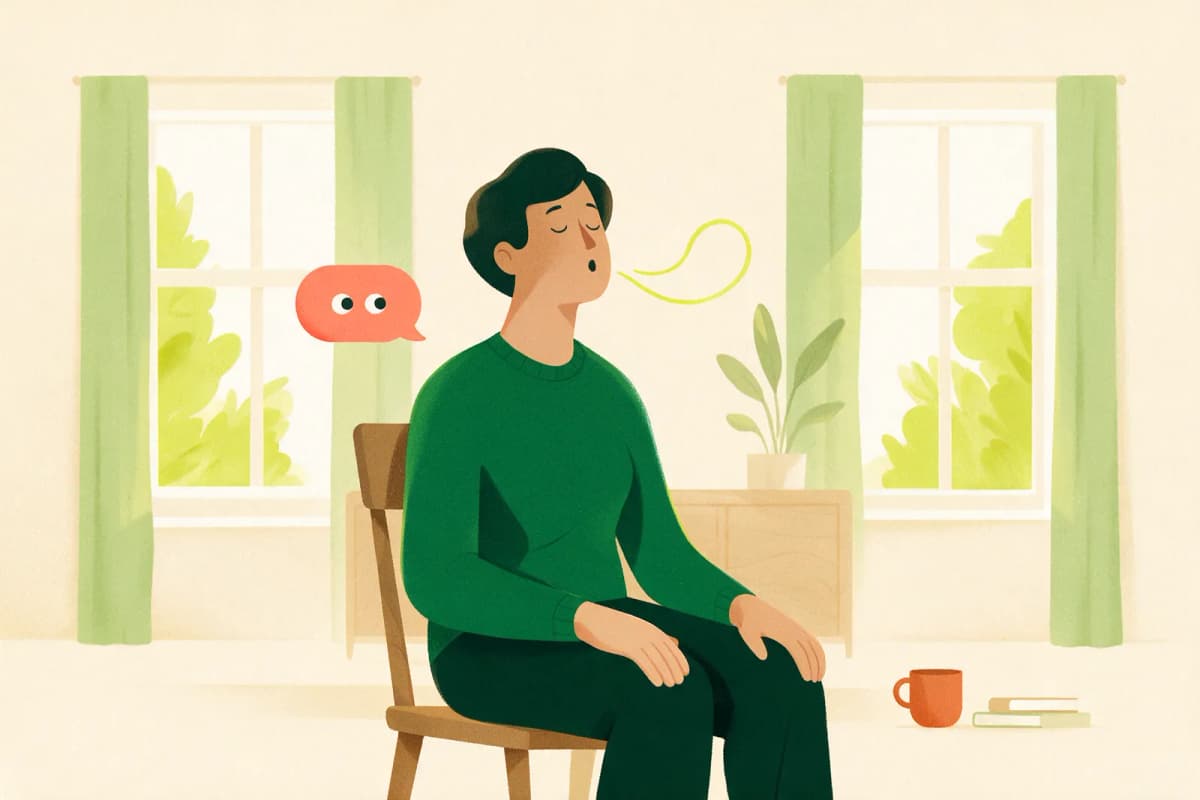
Twelve statements. Answer for how things usually are.
Think about speaking to a group: a meeting, a class, a talk, a toast. There are no right answers.
Private: your answers are scored in your browser and never sent to us.
THE BASICS
What public speaking anxiety is
Public speaking anxiety is fear or dread about speaking in front of other people, whether that's a talk, a meeting or a toast. Researchers describe it as showing up in three ways: in the body (a racing heart, shaky hands, a dry mouth), in your thoughts (worry, a blank mind, replaying mistakes) and in what you do (rushing, or avoiding the chance altogether).[5]
It's one of the most commonly reported fears, and research reviews treat it as a form of social anxiety.[4] Feeling nervous before something that matters is normal. It becomes a problem when it starts deciding what you do.
THE RESEARCH QUESTIONNAIRES
The PRPSA and the PRCA-24
If you searched for a “public speaking anxiety test”, you may have come across these two. Both were developed by communication researcher James C. McCroskey and are widely used in research and teaching.
PRPSA: Personal Report of Public Speaking Anxiety
Thirty-four statements, each answered on a five-point scale from strongly disagree to strongly agree. Some statements are worded calmly and scored in reverse. Totals range from 34 to 170. The published bands are low (below 98), moderate (98 to 131) and high (above 131), with a reported mean of 114.6. McCroskey describes it as highly reliable, and focused strictly on public speaking.[1]
PRCA-24: Personal Report of Communication Apprehension
Twenty-four statements covering four settings: group discussions, meetings, one-to-one conversations and public speaking. Each setting gives a sub-score from 6 to 30, and the total ranges from 24 to 120. For the public speaking sub-score, the published norms give a mean of 19.3, with above 24 counted as high and below 14 as low. McCroskey notes that the sub-scores are less reliable than the total, and recommends the PRPSA for anyone interested only in public speaking anxiety.[2]
Why our self-check is different
McCroskey's measures are published for research and instructional use.[3] Rather than reproduce them on a commercial site, we wrote our own short self-check and link to the originals, so you can take them as published. Our twelve statements are not validated and are scored on a different scale, so your result here can't be compared with a PRPSA or PRCA-24 score.
WHAT TENDS TO HELP
Small steps, out loud
A 2019 meta-analysis of 30 randomised controlled trials found that psychological treatments for fear of public speaking reduced it, with smaller benefits for wider social anxiety too.[4] Many of those treatments share a few ingredients you can borrow, carefully, in everyday practice:
- Start small and build up. Avoiding speaking tends to keep the fear going. Pick a step that feels manageable, such as one comment in a meeting, and work up from there.[6]
- Rehearse out loud, not just in your head. Saying the words, ideally recorded, makes the real moment feel more familiar. Most people also sound steadier on playback than they felt.
- Slow your breathing. Breathing exercises are among the NHS's self-help suggestions for social anxiety.[6] A slow breath out before you begin is a simple place to start.
- Plan your first 30 seconds. Nerves are often strongest at the start. A practised opening line, said a little slower than feels natural, carries you into the part where you settle.
None of this is a cure, and it isn't a replacement for treatment if your anxiety is severe.
WHEN TO GET SUPPORT
If it's more than nerves
This self-check can't diagnose anything. If fear of speaking stops you doing things you want or need to do, causes panic, or is affecting your work, studies or relationships, please talk to a GP or a therapist. Talking therapies such as CBT are recommended for social anxiety, and in England you can refer yourself to NHS talking therapies without seeing a GP.[6] If you're outside the UK, your doctor or a local mental health service is a good first step.
PRACTISE PRIVATELY
Start with one private minute
SpeakConfident is a speaking coach, not therapy. It gives you a low-stakes place to rehearse: record a short take on your own, hear it back, get one thing to try, then do a second take. Nobody else hears it, and you choose when to move on. Chapter 7, Under Pressure, works on a slow start, pausing to buy time and staying steady through a hard question.
One minute, no account needed. You can delete your recording at any time.
QUESTIONS
About speaking nerves
Is this the PRPSA or the PRCA-24?
No. It's our own short self-check, written for this page. The PRPSA and PRCA-24 are research questionnaires by James C. McCroskey; we explain them below and link to where they're published. Our check is not validated and its bands are not population norms.
Is fear of public speaking normal?
Yes. It's one of the most commonly reported fears, and research reviews describe it as a form of social anxiety. Feeling nervous before a talk is not a sign that something is wrong with you.
Can public speaking anxiety be treated?
Yes. A meta-analysis of psychological treatments for fear of public speaking (Ebrahimi and colleagues, 2019) found that they reduced it, and the NHS lists talking therapies such as CBT for social anxiety. If it's affecting your life, a GP or therapist is a good first step.
Does practising actually help with nerves?
For many people, rehearsing out loud and building up from small, low-stakes situations helps the real thing feel more familiar. It isn't a cure, and it isn't a replacement for treatment if your anxiety is severe.
Are my answers stored?
No. The self-check runs in your browser. Your answers aren't sent to us or saved anywhere.
Sources
- McCroskey, J. C. Personal Report of Public Speaking Anxiety (PRPSA). Published at jamescmccroskey.com. Original source: McCroskey, J. C. (1970). Measures of communication-bound anxiety. Speech Monographs, 37, 269–277. www.jamescmccroskey.com/measures/prpsa.htm
- McCroskey, J. C. Personal Report of Communication Apprehension (PRCA-24). Published at jamescmccroskey.com. Source: McCroskey, J. C. (1982). An introduction to rhetorical communication (4th ed.). Prentice-Hall. www.jamescmccroskey.com/measures/prca24.htm
- Communication research measures: terms of use (research and instructional purposes). www.jamescmccroskey.com/measures
- Ebrahimi, O. V., Pallesen, S., Kenter, R. M. F., & Nordgreen, T. (2019). Psychological interventions for the fear of public speaking: A meta-analysis. Frontiers in Psychology, 10, 488. doi.org/10.3389/fpsyg.2019.00488
- Bodie, G. D. (2010). A racing heart, rattling knees, and ruminative thoughts: Defining, explaining, and treating public speaking anxiety. Communication Education, 59(1), 70–105. doi.org/10.1080/03634520903443849
- NHS. Social anxiety (social phobia): symptoms, self-help and treatment. www.nhs.uk/mental-health/conditions/social-anxiety
Curious how you come across?
The speaking style quiz finds the one delivery habit listeners notice first.
Find my speaking style