HOW IT WORKS
Record. Replay. Rep.
Good speakers improve by listening back, changing one thing and trying again. SpeakConfident turns that into a short daily rep: you speak, the app measures what a listener hears, and your coach gives you one thing to try on take two.
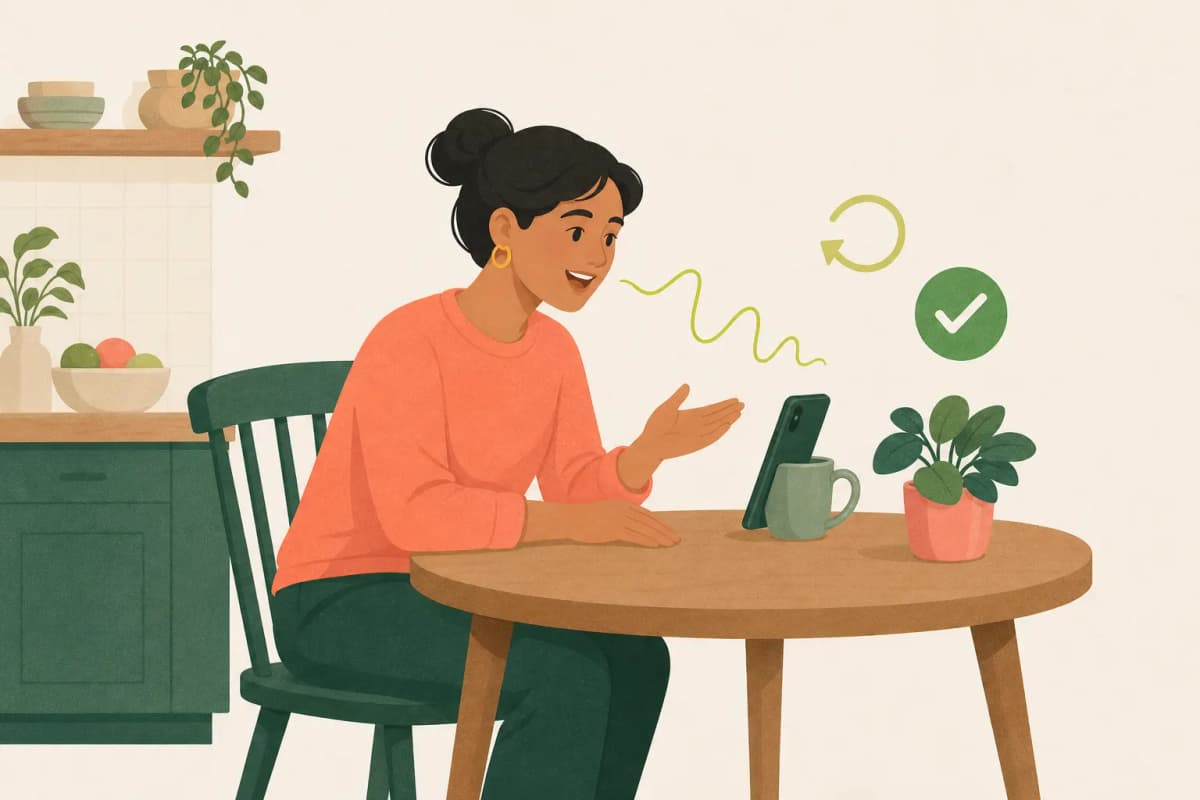
ONE REP
Five steps, about four minutes.
Every rep follows the same loop, so you always know what comes next.
Learn one idea
A sentence of theory, a cue you can act on, and an example you can play first.
About 30 secondsRecord take 1
Read a short line or answer a prompt in your own words. Most takes run 30 to 60 seconds.
Up to a minuteSee your Replay
Your transcript comes back marked: fillers struck out, rushed and rising endings flagged, punched words in bold.
A few seconds to analyseHear one fix
Your coach names one thing to keep and one thing to change, quoting your words. Tap “Hear it better” to hear the line said well.
About a minuteTake two, and overdo it
Say it again and exaggerate the fix. Then see the before and after side by side, measured the same way.
Up to a minute
WHAT GETS MEASURED
Five things a listener notices.
Your take is turned into text with a timestamp for every word. Pitch and loudness are read on your device. The coach only writes feedback once those numbers are in.
- Pace
- How it’s measuredWords per minute, worked out from the timing of every word. The app also checks whether your last few sentences speed up compared with your opening.
- What the coach looks forRoughly 130 to 165 words a minute for most people. If you speak carefully or English is your second language, you can switch on a relaxed pace target that starts at 112.
- Pauses
- How it’s measuredThe gap after every sentence. A gap of about a third of a second counts as a real pause. A long silence in the middle of a sentence counts as a hesitation instead.
- What the coach looks forA pause after most of your sentences, so each one has room to land. Sentences that run straight into the next are marked.
- Fillers
- How it’s measuredEvery um, uh and er, plus padding like “you know,” “I mean,” and sentences that start with “So,” or “Basically”. Words that might be fillers, like “like” or “kind of”, are shown but never counted.
- What the coach looks forTwo or fewer a minute. You see each one struck out, so you know exactly where they crept in.
- Melody
- How it’s measuredHow much your pitch moves, measured on your own device while you record. Statements that rise at the end, so they sound like questions, are flagged.
- What the coach looks forA voice that moves up and down, with statements that land down at the end.
- Punch
- How it’s measuredLoudness, also measured on your device. The app looks for words that clearly stand out from the rest of the sentence, and endings that fade away.
- What the coach looks forKey words that land, and sentences that keep their strength to the last word.
Endings get special attention, because that’s where nerves show. A rushed ending, a statement that goes up like a question, or a last word that fades out are each marked on your transcript.
What the coach won’t do
- Score your accent, your personality, your emotions or your “confidence”.
- Give you an overall grade. You get five levels you can change, and nothing else.
- Hand you a list of ten things to fix. You get one thing to keep and one to change.
- Correct your pronunciation or try to make you sound like someone else.
- Ask you to take its word for it. Every note points to a moment you can replay, and you can tap “Not quite” when it’s wrong.
THE PATH
Ten chapters, one skill at a time.
You start with a Voice Snapshot, a 60-second recording that shows where you begin. Each chapter ends with a rep for your own real moment and then a checkpoint, where you hear today’s take next to that first one.
The Mirror Hear yourself, catch the fillers · Free
Count your ums, swap them for a breath, drop the starter words and finish with one clean minute.
Finish it to reach: StarterPause & Pace Slow down, own the silence
Stop at the full stops, pause before the word that matters, slow the last line and let a question land.
Finish it to reach: SpeakerVolume & Punch Project and punch key words
Reach the back row, lean on one word, punch a contrast and stop your sentences fading out.
Finish it to reach: PresenterMelody & Tone Use your whole vocal range
Read with expression, land statements down, and choose when to sound warm and when to sound firm.
Finish it to reach: PerformerStructure What? So what? Now what?
Lead with the point. Practise What? So what? Now what?, the rule of three, signposts and a clear ask.
Finish it to reach: CommunicatorStory Hook, detail, point
Open with the moment, add one detail people can see, voice the dialogue and finish on the point.
Finish it to reach: StorytellerUnder Pressure Calm body, clear answers
Start slow and low, stay steady through a tough question, handle pushback and say “I don’t know” well.
Finish it to reach: LeaderSay Less Short, clear, memorable
Cut the warm-up, say it in half, give the one-sentence answer and the 30-second version.
Finish it to reach: Straight TalkerThe Room Meetings, questions, pushback
Speak up early, jump in politely, disagree without heat and sum up the meeting.
Finish it to reach: Voice of the RoomShowtime Warm up, open strong, finish well
Warm up your voice, own the first 30 seconds, give the toast, make the pitch and land the closing line.
Finish it to reach: Headliner
A WEEK OF PRACTICE
Little and often beats one long session.
Here’s what a normal week can look like. It fits around work, and the free plan covers it.
- MonOne repFour minutes, two takes, one fix.
- TueWarm read60 seconds to keep your streak.
- WedOne repThe next rep on your path.
- ThuWarm readOr skip it: a freeze covers one missed day.
- FriOne repTry the fix in a real meeting or call.
- SatRestNothing to do.
- SunOne repThen read your weekly note from the coach.
Each rep ends with a small mission for the day, like pausing for two seconds before you answer a question. That’s where the practice meets real life.
WHERE THE IDEAS COME FROM
Built on how speaking is taught.
The path uses ideas that speaking coaches have taught for years: record and review yourself, treat your voice as a set of tools (pace, volume, pitch, pause and tone), exaggerate in practice, lead with the point, tell stories for a listener, and give feedback as one strength and one change. The exercises and wording are our own, and no coach or organisation endorses the app.
QUESTIONS
About the method
How long does a rep take?
About four minutes: a short idea, two recordings of up to a minute each, and your Replay and coach notes in between. A warm read takes 60 seconds.
Do I need to read a script?
Some reps give you a line to read, so you can focus on one skill. Others ask a question and you answer in your own words. Those prompts come from the goal you picked, like meetings, interviews, presentations or everyday life.
Why only one fix at a time?
Because one change is all you can try in a 60-second take. Working on one thing, then hearing it on take two, is how the change becomes a habit you take into real conversations.
What does “overdo it” mean?
Make the fix bigger than feels natural. If the cue is to pause, pause for longer than you think you should. In practice it feels like too much. To a listener it usually sounds about right.
How do levels work?
Each skill has a level from 1 to 10. Your Voice Snapshot gives you a starting read. After that, a level only rises once you have three measured takes, and it’s based on your typical take over your last five, not your best one, so a lucky take can’t push it up. Reading aloud from a script counts towards pauses only. Levels never go down.
What happens at the end of a chapter?
You record a checkpoint: a fresh 60-second prompt, about as easy as your first Voice Snapshot. You hear it next to that first recording and see how your levels have moved. Your rank goes up with every checkpoint.
Is any of this free?
Yes. Your Voice Snapshot, Chapter 1, daily warm reads, one surprise question a day and 4 coached reps a week are free. Chapters 2 to 10 are part of Pro.
Start with one minute.
Your Voice Snapshot shows your five levels and your marked transcript. No account needed.
Record my free Snapshot See what’s free and what’s Pro